Hello everyone,
Note: Part 2 (October 2014) of this post can be found here. Part 3 (June 2015) can be found here.
I have run into this situation twice in the past week:
Both people had signed up for Comcasts XFINITY Extreme 50 High Speed Internet (50 Mbps download speed), but neither were getting the promised speeds. In fact they were only getting about half (24 Mbps) of what they were paying Comcast for. What was going on here? Was it Comcast again?
Actually no! I found out that two essential things were missing from each persons network setup:
1) The Modem: If your Comcast connection rate is 20 Mbps or greater your modem should be a DOCSIS 3.0 Cable Modem. Once again, you must use a DOCSIS 3.0 Modem in order to take full advantage of Comcast’s fast Internet speeds! You can rent one from Comcast or buy your own. I recommend buying your own.
2) The Router: Your router must have both LAN and WAN Gigabit functionality. The WAN Ethernet 10/100/1000 Gigabit ports are for establishing a wired connection to your broadband Ethernet-enabled DOCSIS 3.0 modem. The LAN Gigabit Ethernet ports are for establishing high-speed wired connections to your desktop PC. Once again, connect the router to the cable modem through a Gigabit WAN port, and connect your other PCs, servers, wireless-N access points, or anything else to the LAN Gigabit Ethernet Ports.
Once the DOCSIS 3.0 Modem and the Gigabit Router were hooked up, download speeds of over 50Mbps came flowing in!
Professor Randy says: Don’t buy a router that doesn’t have both LAN and WAN Gigabit ports, and don’t expect extreme Comcast download speeds without a DOCSIS 3.0 Modem!




2:19 pm on March 8th, 2012 1
A hearty AMEN to the point about the DOCSIS modem, Professor! I recently swapped out my old circa-2001 cable modem (probably a DOCSIS 1.0 vintage) for a DOCSIS 3.0 and my Internet speed went from about 10Mbps to just over 20Mbps. It also seems like the new modem is not as affected by the evening prime-time TV and Internet “rush hour”, slipping back only to around 15Mbps. The old modem used to drop severely at times to below 1Mbps!
9:36 am on July 1st, 2012 2
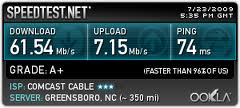
Also a point of failure could be the protocol between the router and the computer. For instance, I’ve been using a cheap wireless adapter and getting speeds about 15mbps down. Once I switched over to Fast Ethernet (cat5e), I’m getting 61mbps down. BIG difference.
3:04 pm on July 8th, 2012 3
Thanks for the comment Stephen,
You are so right! Wired will always be faster than wireless.
I recommend Cat5e for 100mbit networks and Cat6 for gigabit networks.
To fully take advantage of Cat6, you need all gigabit hardware (NICs) and a gigabit Switch (or gigabit ports in the router). If not, your Cat6 will just get you Cat5 speeds.
Best wishes and thanks for visiting my blog.
12:16 pm on March 2nd, 2013 4
I was going around in circles trying to find out if my 7 year old router was the reason my wireless speeds were half the speed of my ethernet speeds. That is, until I read your very helpful article. My modem is docsis 3.0 – I picked it up a few months ago when I upgraded my comcast service – so all good there. Did some more searching to check my router specs and sure enough, no gigabit wan/lan functionality. I figured it was my old router but wasn’t sure why. Thanks again!
12:25 pm on March 2nd, 2013 5
Hello Jon T,
Thanks for the comment. There is nothing more frustrating than slow wireless speeds! I see this problem all the time with my Comcast clients. I’m glad that the information in my post was helpful. Thanks for reading and commenting.
Best wishes,
Randy Knowles
12:46 am on April 10th, 2013 6
Hi Randy…
Quick question: Wouldn’t a router with up to 100Mb speeds be sufficient?
12:59 pm on April 10th, 2013 7
Thanks for the comment Scot,
It’s important to remember that, though a router has a 100 Mbit/s Ethernet port, it DOES NOT mean it can actually route traffic at 100 Mbit/s. Old Cisco 2620/2621 routers had 1 or 2 10/100 Fast Ethernet ports, but you were lucky to push 20 Mbit/s through them.
Many so called 100Mbit ports on a modem actually can’t handle more than 35Mbit in traffic (speedtest throughput). Many modem specs are in error.
These faster broadband services are going to expose a lot of existing modem and router bottlenecks. Anybody getting new equipment should definitely go gigabit all the way (LAN and WAN).
Best wishes,
Randy Knowles
9:16 pm on May 8th, 2013 8
Quick question on the wireless aspect. While I expect it to be slower, I would not expect that slow. I am getting over 50Mbps over the ethernet but my wireless is only 10Mbps or so. I have a netgear WNDR 3300 router. I know its a bit older but I would expect to be getting closer to at least 15-20. I have played around with channels and other things to no avail.
3:05 pm on May 16th, 2013 9
Similar to Carl’s question, I have 50 mpbs when I hook-up my laptop to Modem directly (Docsis 3.0), but when I go wireless, I get less than 15 mbps even when I am sitting next to Router (Netgear WNDR3300). What I may be doing wrong.
12:58 pm on May 19th, 2013 10
Thanks for the comment Carl,
Poor wireless reception can be caused by a multitude of things. Here are some of the things that I check for when I do my service calls:
1) Set the router to another channel. I try channel 11 first, then channel 6, then channel 1.
2) Try the 5GHz band if the router has this option.
3) Change the position of the router. There may be signal interference due to certain obstructions.
4) Check to see if the router needs a firmware update.
5) The receiving device may have a bad wireless adapter. Try an external dongle.
6) Are the router and the receiving device both wireless “N” protocols? If the router is “N” capable but the receiving device is only b/g then you won’t get “N” speeds. If both devices are “N” capable then don’t use any mixed b/g/n settings in the router. Use “N” only.
7) When setting the security in the router, use WPA2-PSK with AES.
8) Check all Network settings in the computer. I usually disable all wireless network adapter protocols except for Internet Protocol Version 4 (TCP/IPv4). Don’t disable the ones that your client needs!
9) I flush the DNS cache (ipconfig /flushdns in “Run” box) and then change the routers settings to point to OpenDNS.
10) When possible I always try to use the same brand of router and wireless adapter. For example, if using a D-Link router, also use a D-Link wireless USB adapter.
11) And finally, you may very well have a bad router! Try another one or get a new one!!
Best wishes,
Randy Knowles
1:00 pm on May 19th, 2013 11
Thanks for the comment Nick,
Poor wireless reception can be caused by a multitude of things. Here are some of the things that I check for when I do my service calls:
1) Set the router to another channel. I try channel 11 first, then channel 6, then channel 1.
2) Try the 5GHz band if the router has this option.
3) Change the position of the router. There may be signal interference due to certain obstructions.
4) Check to see if the router needs a firmware update.
5) The receiving device may have a bad wireless adapter. Try an external dongle.
6) Are the router and the receiving device both wireless “N” protocols? If the router is “N” capable but the receiving device is only b/g then you won’t get “N” speeds. If both devices are “N” capable then don’t use any mixed b/g/n settings in the router. Use “N” only.
7) When setting the security in the router, use WPA2-PSK with AES.
8) Check all Network settings in the computer. I usually disable all wireless network adapter protocols except for Internet Protocol Version 4 (TCP/IPv4). Don’t disable the ones that your client needs!
9) I flush the DNS cache (ipconfig /flushdns in “Run” box) and then change the routers settings to point to OpenDNS.
10) When possible I always try to use the same brand of router and wireless adapter. For example, if using a D-Link router, also use a D-Link wireless USB adapter.
11) And finally, you may very well have a bad router! Try another one or get a new one!!
Best wishes,
Randy Knowles
12:10 pm on June 25th, 2013 12
hi randy! thanks for the great thread! so i have a medialink wireless n router and a Motorola surfboard sb6121 with comcast 50mbps but i am getting only 22… what is going on here???
10:10 pm on June 29th, 2013 13
Hello Barry,
Thanks for the comment. You say that you have a wireless N router but if it’s not gigabit then you won’t get the speed that you are looking for from Comcast. The Motorola Surfboard modem that you have is great but your router is the problem! Check out this video: http://www.youtube.com/watch?v=WL4-cBdKi-M
Best wishes,
Randy Knowles
9:40 pm on August 7th, 2013 14
I have a DOCSIS 3.0 modem and a high end EA3500 router and only getting speeds of ~3.0 Mbps with a 50 Mbps plan. I don’t know whether it’s a Gigabit router, but the lack of that shouldn’t account for such poor speeds.
9:53 pm on August 10th, 2013 15
Thanks for the comment Adam,
Your speeds are very slow and many things could be going on. Take a look at this EA3500 troubleshooting link and something there may help you:http://community.linksys.com/t5/Wireless-Routers/EA3500-Slow-Internet-Speeds-Wired-amp-Wireless/td-p/629708
Best wishes,
Randy Knowles
2:51 pm on August 23rd, 2013 16
Hey all, I’ve been having this same issue with my own ISP and cable modem / wifi router setup and think I finally found the bottleneck. It seems to be TKIP encryption primarily, but also could be WPA-PSK in combination as well. I too am paying for 50mbps and was only getting 20mbps on my wifi but near 50mbps on my wired.
I have a ZOOM 5350 cable modem (w/ built-in wifi) but the wifi signal wasn’t great. I decided to buy a Medialink 300N wifi router and make that the dedicated access point and disable the ZOOM wifi. To my dismay, it didn’t make much difference… so I knew it had to be something in the router settings.
Long story short, I found the perfect combo of settings that made a world of difference for me… I have now jumped from 20mbps to 30-40mbps on wifi:
-Network Mode: 11b/g/n Mixed Mode
-Channel: 11
-Bandwidth: 20 MHz
-Security Mode: WPA2-PSK (<– only! Not WPA or WPA/WPA2 Mixed, etc.)
-WPA Encryption: AES (<– only! Not TKIP or TKIP+AES mixed)
I tried these settings on both the Medialink signal and my original ZOOM modem signal and it yielded improvements to both, so I know these are proper settings that make a difference. Although I must say the Medialink 300N is still a better wifi signal than my ZOOM modem has because it's yielding more mbps improvement than the ZOOM signal.
In conclusion, it helps to have a dedicated wifi router (the built-in w/ modems don't usually seem to be as good), but also don't expect you will ever be hitting the full 50mbps bandwidth on wifi either… it just ain't gonna happen. Wired connections FTW on speed, but try these settings and hopefully it will maximize your wifi at least.
Good luck!
8:38 am on November 9th, 2013 17
Alright, here’s the issue you’ve all been waiting for…
Upgraded to 50Mbps service, got the DOCSIS 3.0 modem. Ethernet line to PCDesktop get 57Mbps.
Then, I added a Netgear N900 Dual Band Gigabit router. All wifi signals super high at 40 to 57 MBps, but my ethernet to PCDesktop drops to 27Mbps.
Went through Netgear cust support, and we made ethernet as fast as possible. Hooked Ethernet line to the MACDesktop and get 57MBps.
The PCDesktop is older and so I updated ethernet network drivers, but, alas, no improvement.
(That’s the first time I have used the word “alas”)
I think my PCDesktop is 10/100 and need to upgrade to 10/100/1000. <<I'm not sure what that means. I suppose I try a USB dongle first?
Any thoughts on how I can get speedy speeds here? THANKS ALL..
3:52 pm on November 24th, 2013 18
Randy,
I really appreciate you providing all this info. I recently upgraded to Xfinity Blast Plus (50Mbps internet). I hooked up Motorola SB6121 Xtreme cable modem with NetGear N600 Model WNDR 3400v2 router. If I connect my laptop directly to the router using Ethernet cablesI was getting 52Mbps. But when I sit near the router and connect using wireless (wireless N) I was getting barely 18 – 22Mbps. I followed what you listed in these posts and just by changing the channel in the router to 11 from Auto I am no getting 43 Mbps. I am a happy customer. Thanks a Lot!!!
10:18 pm on November 25th, 2013 19
My happiness is shortlived. When i changed the channel on my router from Auto to 11 yesterday, my download speeds were more than 50 mbps. But I checked today and again it dropped to 10-15Mbps. I Played around with the channels one more time and again I saw the speeds of 50 Mbps pon wireless but it seems to go down after some time and I do not understand why.
Randy, Help….
10:24 pm on November 27th, 2013 20
Thanks for the comment trishul,
There are so many factors that could be causing your download speed drops. How many other devices and/or obstructions are there in your environment? Are there many 802.11 networks in your area? Is your router capable of transmitting on the 5GHz frequency? If so, give it a try.
Check out this article by Cisco: http://www.cisco.com/en/US/prod/collateral/wireless/ps9391/ps9393/ps9394/prod_white_paper0900aecd807395a9_ns736_Networking_Solutions_White_Paper.html
Best wishes and let me know how things go,
Randy Knowles
5:15 pm on December 26th, 2013 21
Howdy! :-)
after replacing comcast modem with a newer comcast modem and following Jim’s directions for security protocols, wifi speed has improved from 20mbps to 30mbps. I’m subscribed for 50mbps. so there is still room for improvement. the new modem is docsis 3, certified/delivered by comcast.
I’ve set the channel to the best rated per wifi app scan to 1. the modem has only 2.4GHz option. No 5GHz. So wasn’t able to go that way.
‘ been reading elsewhere that the ultimate resolution to this problem is to either bridge the gateway-style modem, or change to a real router-modem pair.
Any other insights you can help me with would be greatly appreciated.
Thank you for being out there!
:-)
11:48 pm on January 3rd, 2014 22
Hi
i had a very hard time switching routers and modem to get that 50 mb speed
I tried Comcast’s recommended modem which comes with built in wife router , ive tried zoom modem built in router …. and other routers but i still get 24.
after using Comcast modem which they had recommended , they blame the problem on my laptops and said is there any other thing we can help u with !!???
5:10 pm on January 9th, 2014 23
I understand a wired connection is always faster bit what about a wireless router? Any suggestions? I have a 50Mbs connection and get a max of 20-25Mbs through my wireless connection.
Any suggestions to assist?
5:58 pm on January 9th, 2014 24
Hi Austin,
The speed and range of a wireless connection involves many factors. If you just want to focus on the router factor then I recommend this one (I don’t know what your budget is): http://www.amazon.com/gp/product/B006QB1RPY?tag=thewire06-20&linkCode=as2&creative=374929&camp=211189.
This is a great router but beware, it won’t solve any dead zones you may have in your area of transmission/reception. Maybe your house is too large, or maybe there are too many obstacles between your router and certain spots in the house. Like I said, many factors come into play when you talk about wireless connections.
Best wishes,
Randy Knowles
6:05 pm on January 9th, 2014 25
Hi Rits,
Don’t use a Comcast modem! They’re not very good and you have to pay $8.00 a month to rent them.
If you don’t need a telephone connection then I recommend this modem: http://www.amazon.com/exec/obidos/ASIN/B00AJHDZSI/thewire0f-20/?tag=thewire06-20
If you run your phone line through the modem then I recommend this one: http://www.amazon.com/Arris-TM822G-Touchstone%C2%AE-Ultra-High-Telephony/dp/B00721TUNS/ref=pd_cp_pc_2
You can probably find them cheaper on ebay. Best wishes,
Randy Knowles
8:01 am on February 6th, 2014 26
Netgear CMD31T combined with a Linksys EA3500 router – make sure your media prioritization is disabled or properly configured – 45-55 mbps all day long.
10:29 am on March 9th, 2014 27
Hey guys, I have the 105mb package from Comcast. I’m using the zoom 5350 modem/router. Now on the PC (wired) I get between 94mb and 97mb down and 22mb to 27mb up. However, on wireless I’m only getting somewhere around 27mb to 30mb down I’ve tried changing the setting to aes only I’ve turned off the ip flood detection, and have changed so many different setting it’s hard to list them all. I can’t get even close to the 105mb. Is there something I’m missing? I’ve even changed the password so nothing else on the network is connected except my iPhone 5 which has wireless N capabilities . Still no change. Anybody have any help for me?
2:11 pm on March 22nd, 2014 28
Hi all, found this article trying to solve the issue of low throughput from the combination of my Motorola Surfboard Extreme DOCSIS 3.0 cable modem and the Netgear R6200 Router. When I logged into the router it was showing only 10M/Full for 10Mbps on full duplex. I tried several times to adjust the configuration on both devices, with no result. When I plugged directly into the modem from my computer, I had 1000M/Full. This made no sense since both devices are set to allow 10/100/1000. Then it dawned on me that the ethernet patch cable supplied with the router was Cat5e not Cat6. A quick run to Staples, albeit begrudgingly since their cords are ridiculously over-priced, net me the Cat6 cable I needed. Brought the whole network down, swapped out the cable, and voila, 1000M throughput. Speedtest.net and speakeasy.com/speedtest confirm 55Mbps down and 12Mbps up. If anyone is having the same issue that I was, please check your cables!
9:59 am on May 25th, 2014 29
when i go to the comcast speed test it says i am getting 60mb/s but when i go to say download a game it says i am only downloading at like 3 – 10mb/s…why is this? i have a I5 pc with an ssd so i assume the slow downloading is network related…please help me
1:04 pm on May 25th, 2014 30
Hi Jason,
There could be many variables in play here but I’ll bet that the site (server) where you are downloading the game is just slow. Comcast is supplying you with a fast internet connection but the game server is slow (this could be caused by several factors).
Best wishes,
Randy Knowles
9:51 am on June 20th, 2014 31
Jason –
The reason for this is because of measurement values. Your speed test (and Comcast advertising) are measured in Megabits (Mbps), whereas browsers or download clients will display your download speeds in Megabytes (MBs). One Megabyte is made up of 8 Megabits. So 60Mbps = 7.5MBs. Your 3-10 range is just due to fluctuations.
6:46 pm on August 3rd, 2014 32
I just got internet with Comcast and they gave me the Arris TG852G Modem/Router. I got the 50mbps down and 10 up package. The best speeds I’ve seen through wireless is 29down/5.5up but it isn’t consistent at times I’ve had it drop below 1mbps down and up. When connected with Ethernet I consistently get 25-30mbps down and about 6 up. I’ve changed some of the settings like the channel to 11 but I haven’t seen a difference in performance. Can anyone help or tell me what speeds I should expect with this modem combo.
1:25 pm on August 11th, 2014 33
I see above that you recommended the RRIS / Motorola SurfBoard SB6141 DOCSIS 3.0 Cable Modem for users that don’t need telephone service (Jan 9, 2014 post)
If I’m renting from Comcast, and want to buy instead – I don’t use phone, and need the modem, router and wifi function do you recommend
ARRIS / Motorola SURFboard SBG6580 DOCSIS 3.0 Cable Modem and Wi-Fi N Router?
I’m paying for the 50 mps download blast speed.
Also since my house has dead zones (size, configuration) I have always used a range extender will this effect my download speeds??
Thanks for any feedback, I want to have a unified system working close to the purchased speeds if possible
8:08 pm on August 11th, 2014 34
Hello Gil,
I still recommend the SB6141. As a dedicated router I would go with the ASUS RT-N66U. I don’t like modem/router combos.
Use CAT6 ethernet cable throughout. You will definitely get 50 Mpbs wired.
Your wireless speeds depend upon many factors but with the above set up you should get maximum speed.
I don’t think that range extenders work very well but if you must go with the inexpensive BearExtender PC Long Range WIFi Booster (it will extend up to 100 feet).
Best wishes,
Randy Knowles
12:43 am on September 13th, 2014 35
I just set up my comcast cable/internet service that is supposed to be 50mbps however when I walk 15 feet into my room, my internet speed drops substantially to around 5mbps, as where when im sitting in front of the modem/router i rented from comcast, my download speed is roughly 25mpbs.
I understand the rented equipment is shoddy, but being a college student living in an apartment, the means to purchase better equipment is non existent. DO you have any suggestions on ways I can tweak settings and what not to optimize the speed of the equipment I have at the moment?
8:06 pm on September 24th, 2014 36
Hi Christian,
Which Comcast modem/router are you using? It must be a DOCSIS 3.0 cable modem (http://customer.comcast.com/help-and-support/internet/wireless-gateway-1 and http://customer.comcast.com/help-and-support/internet/wireless-gateway-2/). If you’re using your own router then you must put the Comcast modem/router into bridge mode (which eliminates all router functions so that you can then use your router of choice).
What are the walls made of between the router and your room? Have you ever tried the Wi-Fi 5 GHz band? Are you using Cat 6 Ethernet Cables? Have you tried channel 11?
Best wishes,
Randy Knowles
1:57 pm on October 20th, 2014 37
Hi Randy! Thanks for the great thread!
I have a Motorola surfboard sb6121, Netgear R6200 Router with comcast 105mbps. I get 98 mbps speed when i connect through cable from the modem.
But, when i connect through cable from router i get speeds around 50mbps and when i connect through wifi i get speeds around 15mbps.
I there any connection settings to get the correct speeds.
Thanks
7:45 pm on October 20th, 2014 38
Hi Ragu,
Have you seen my most recent post on this topic? Take a look and then get back to me if you need to: https://randythetechprofessor.com/not-getting-50-mbps-download-speed-from-comcast-heres-how-part-2
Best wishes,
Randy Knowles
6:02 pm on October 27th, 2014 39
Hi Ragu,
I have received many comments from my first Comcast post back in March of 2012. Many people in my area, and around the country are using Comcast and there are many questions about both wired and wireless Internet speeds. Here are my latest suggestions:
1) Comcast has increased their Internet speeds: “Performance” now offers speeds up to 50 Mpbs (up from 25 Mbps), “Blast” is now 105 Mbps, (up from 50 Mbps), and “Extreme 105” has been bumped to 150 Mbps. I have not seen the 150 Mbps offer in my area of Tennessee.
2) Comcast has come out with new Docsis 3.0 modem/routers in order to handle their speed increases. The two that I am seeing in my area of service are the Wireless Gateway 1 and the Wireless Gateway 2. You can rent these modem/routers from Comcast or buy them. I would buy them if I were you.
3) These new modem/routers are very decent. They have four 10/100/1000 Gigabit Ethernet Ports and they will definitely get you the speeds (wired) that Comcast advertises.
4) The wireless capability of the router is not bad (the Wireless Gateway 2 is dual band). If you want more speed/distance, call Comcast toll free (855-308-9452), and have them put the Gateway into “Bridge Mode”. Then you can use your router of choice (make sure that it is a 10/100/1000 port/switch router). Even though 802.11ac speeds are higher than 802.11n, I don’t think that they are high enough to justify the higher price.
5) Once the Comcast technician has put the router/modem into bridge mode, ethernet ports 2, 3, and 4 will no longer work (disabled). Connect a Cat6e cable from port 1 of the Comcast Gateway to the WAN port (Uplink/Internet) of your router of choice. Now you can configure your router as you like.
6) Wireless speed will vary (router positioning, house construction and layout, etc.), but it will be very good. If you are paying for the 105 Mbps tier your wireless speeds will of course be faster than that of the 50 Mbps tier.
Best wishes,
Randy Knowles
7:18 pm on November 4th, 2014 40
I just got the 50MB speed from Comcast. I have a Motorola SURFboard 6120 Docsis 3.0 modem and a Cisco-Linksys E2000 router. I get 50+ MB on 1 desktop using a wired connection and running windows vista, and 50-60MB on one wireless desktop with windows 7, and an older desktop running windows XP with a wired connect only gets about 30MB speed. I also have 2 Alienware Laptops using wireless, but they only get between 10-16MB speed. I cannot figure out why the laptops are running so slowly. Alienware M17x r1, and M17x r3 both running Windows 7.
Any ideas on what specifically to check for on the laptops?
8:54 pm on November 4th, 2014 41
Hello David,
Have you read this post?: https://randythetechprofessor.com/not-getting-50-mbps-download-speed-from-comcast-heres-how-part-2
Are you using cat6e cables from modem to router. Are the wireless adapters in the alien laptops gigabit capable? The M17 only has 802.11 draft-n support. The M17R3 has Gigabit Ethernet.
Update router firmware, update wireless adapter drivers. It could be various things. The Motorola modem has been known to have some problems with Comcast. Check the wired speed of the laptops.
Best wishes,
Randy Knowles
11:46 pm on November 4th, 2014 42
Well the R3 should have up to 450Mbps when I looked at the card stats, but it is only downloading at 14Mbps. It has the Killer Wireless-N 1103 card.
As for my M17x r1, I have ordered a new card: Intel Network 7260.HMWG WiFi Wireless-AC 7260 H/T Dual Band 2×2 AC+Bluetooth HMC
9:16 pm on November 16th, 2014 43
baloney. i pay for 50 Mb/s and only get an average of 18-20 Mb/s. i’ve spent hours in online chats to comcast billing, sales, and technical with no success. i have a newer 3.0 motorola modem. i’ve also had a technician to my house who determined the problem was outside so an outdoor tech tried to fix the problem. finally i suggested they check their line amplifiers and they replaced one but left an old part in place. finally they replaced the amplifier and the other part.
my conclusion is that comcast is a monopoly with a monumentally imcompetent customer service system and they only want more and more money. i started out paying $29.99/month and now as a loyal customer i pay $69.99/month for a $10 upgrade from 3 Mb/s, which i actually got, to 25 Mb/s and basic cable.
comcast is strongly opposed to any FCC regulation that might force them to deliver on what they promise to deliver to its customers.
10:51 am on December 1st, 2014 44
Comcast is my ISP; they tell me I have been switched to docsis 3.0 service. I have a new Netgear docsis 3.0 modem and an older Linksys router that is hard-wired (not wifi) to the modem and to all computers. I get around 30 Mbps when one computer is connected to the internet via the router. When a second computer connects to the internet via the router, the download speed drops to 8 – 12 Mbps. If I unplug the router, it immediately restores the dowload speed to around 30 Mbps for one computer. It stays at this level if no other computer is connected to the internet, but the speed drops again when a second computer is connected via the router.
Any advice?
2:11 pm on December 2nd, 2014 45
Further information regarding the situation described above:
When the download speed drops to 8 – 12 Mbps, it will go back up to 30 Mbps if the router is unplugged from power, and then plugged in again after a wait of 10 seconds or so.
1:44 am on December 6th, 2014 46
I have a Motorola Surfboard SB 6121 modem which has a docsis 3.0. I connect my laptop to it and get 60 mbps download. I just bought a Linksys WRT 1900AC wireless router. On channels 2.4 and 5ghz I was getting 35 mbps download. I thought I should be getting more so I used an Ethernet cable to plug into the back of the router so I’m hard wired to the router. I’m getting 35 mbps. So somehow I’m losing 25 mbps from the modem to Ethernet port in the router. Is this normal? I question the wireless speed just because at one point I tested 60 mbps wirelessly three times but lost it and never have seen it again. I’m wondering if the router just isn’t setup right.
Thanks,
Chris
10:06 am on February 20th, 2015 47
Can you offer any insights into this mystery? I have DOCSIS 3.0 Netgear combo modem/router. I have two computers running Windows 8.1. The Comcast XFINITY test on the one computer (60 feet from the router) shows a download rate of 51.4 Mbps. The same test on the other computer sitting 1 foot from the router shows 24 Mbps. Both computers are 64-bit and both are using the Google Chrome browser. The computer closest to the router also shows sluggishness on other web access, so maybe there is a clue there. Any ideas?
Help would be appreciated.
Larry
9:44 pm on March 24th, 2015 48
I tried several routers and in the end I followed the Professors’ advice and bought the Asus RT-N66U for $119.99 and yes it was worth every penny. Any good docsis 3.0 modem will do. The Gigabit Wan is a must for 50 Mbps. Some folks just assume and write posts stating that wireless is always slower than wired, not really true if you get the right equipment. I am getting 50+ Mbps wired / 50+ Mbps wireless.
My advice don’t go cheap. Insist on Gigabit Wan port. You’ll see the the jump in download speak much more than tweaking channels.
Another good option if you want to save some $$ is to buy the Netgear C3000 (single band cable/router — no 5G band) but you’ll also get 50 Mbps wire / wireless for about $99.99
8:12 pm on March 25th, 2015 49
Thanks for the comment Ray Ray,
You are so right about the gigabit wan! Glad that the Asus is working well for you.
Best wishes,
Randy Knowles
12:38 am on April 23rd, 2015 50
Hi D. Randy,
Today I upgraded my modem from Docsis 2.0 to Motorola Arris SB6141 docsis 3.0 but the wireless internet speed didn’t change from 20 mbps. The only change is wire internet speed, it reached 60 mbps.
How I can have 60 mbps in wireless.
my router is Linksys e2000 and my internet provider is Comcast.
Please help.
10:25 am on May 22nd, 2015 51
@Hasan, could you connect to ethernet by chance? I have a similar issue in my home. Every hardline PC gets 120+ MBPS down but my laptop only gets 30 MPPS down but my issue is the laptop’s wireless receiver is not fast enough.
9:29 pm on June 5th, 2015 52
Over the past 6 weeks, my Comcast internet (50mbps) has been completely out about half the time. After a tech visit a week ago, I started getting speeds of 2 to 10 over the new Comcast modem with wireless gateway. Today the tech came again and replaced a splitter and an outside wire. I’m getting speeds of over 50 wired and 15-20 wifi. The internet ready TV buffers every 1-2 minutes when I stream Netflix, which is no better than it was before any of the fixes. I rarely ever had trouble streaming before even when I still had the 25 Mbps service. I’m at my wits end with Comcast after spending about 40 hours on the phone with them and waiting a week each time for two tech appts.
10:12 pm on June 5th, 2015 53
Additional info for previous post: TV download speed shows as 700 – 900 kb/sec.
12:12 am on June 6th, 2015 54
Hi Missy,
Thanks for the comment. Possibility #1: Netflix has outgrown its allotted bandwidth, and thus Netflix traffic is now being throttled by Comcast and core network operators.
Possibility #2: Crummy router. Don’t use the wireless capability of the Comcast modem/router. Put the modem/router into “bridge mode”, and use a dedicated router of your choice. Like this one: http://www.amazon.com/dp/B006QB1RPY/ref=asc_df_B006QB1RPY3358692?smid=ASH1H6YCFH4EF&tag=mysimon-pc03-20&linkCode=df0&creative=395105&creativeASIN=B006QB1RPY#customerReviews
Also, go into the Netflix settings and uncheck “best video quality”, and set to “auto”. Position the router in a central area.
Let me know how it goes,
Randy Knowles
11:11 am on August 17th, 2015 55
I was showing speedtests of 3 to 30mbps. Most times 3 to 4mbps. A tech came out from Suddenlink and showed 50mbps coming from the modem. That’s what I’m paying for.
A speed test today showed 3mbps. I did a speed test on my laptop from the same router and it’s showing 50mbps. The speed test on my pc shows the same if I go through my router or connect direct to the modem.
What could be wrong with my computer that the speed is testing so slow? I have an HP that’s about 6 years old and use the Vista os.
Not very good with computers so any help stated simply would be great!
6:09 pm on November 3rd, 2015 56
I’m sorry but after reading this, and knowing this information already I’ve already purchased a DOCSIS 3.0 Modem (Motorola SURFboard SB6121 172 MBps Cable Modem – DOCSIS 3.0) and I have a pretty decent router (Linksys WRT1900AC Wireless AC Dual Band Router AC1900) I’m also using my ASUS PCE-AC68 Dual-band Wireless-AC1900 Adapter IEEE 802.11ac, IEEE 802.11a/b/g/n PCI Express adapter and still received about 27mb/s download rates. Please explain what and where I’m going wrong to “take full advantage” of the “50mb/s” I’m suppossedly suppossed to be getting.
2:09 am on February 17th, 2016 57
I have a wndr3700 v.3 is that a router for good enternet speed
10:30 am on February 12th, 2019 58
Netflix recommends a connection speed of 5 Mbps or faster for HD streaming, but again, that’s for each device that’s connected to your network. It’s also awfully slow, all things considered. If your home internet is capped at 5 Mbps, then technically only one device at a time is able to stream at that speed.